Wednesday, June 13, 2018

Focusing on Collaboration rather than Competition is the Key to our Future

Interprofessionalism and Athletic Training
By: Anthony Breitbach PhD, ATC

In 2007, after over 20 years of clinical practice as an Athletic Trainer, I moved to a faculty position as Director of the Athletic Training Program in the Doisy College of Health Sciences at Saint Louis University.

Over the years, working in both intercollegiate athletics and clinical outreach to high schools, I valued collaboration with other health professions.  Thus, when given the chance to be involved with SLU’s Center for Interprofessional Education and Research, I saw IPE as a vehicle for the AT profession to showcase our skillset and ability to be engaged in Interprofessional Collaborative Practice.  It did not take long to see the benefits of collaboration with other health professionals for me, our program and our profession.

At the same time, I was fortunate to serve on the National Athletic Trainers’ Association (NATA) Executive Committee for Education (ECE), participating in the development of the “Future Directions for Athletic Training Education” report that was accepted by the NATA Board of Directors in 2012.  Part of my role on the NATA ECE was to help develop a plan for strategic implementation of the recommendation for IPE in AT programs.

The first step in this implementation was to bring together a group of 23 colleagues to write a white paper “Interprofessional Education and Practice in Athletic Training” which went through peer review and was published in the Athletic Training Education Journal in 2015.  This paper was recognized by the Athletic Training Education Journal as the “Outstanding Manuscript for Advancing Educational Practice” in 2015: http://natajournals.org/doi/pdf/10.4085/1002170


Our IPEP Work Group formed the nucleus of the NATA IPEP Interest Group on LinkedIn, which now has over 500 members.  This Interest Group also has a Twitter feed, @NATA_IPEP, which has been active informing the AT profession about IPE and IPCP as well as demonstrating to the greater interprofessional community that AT can play an important role in their initiatives.

The NATA IPEP Interest group on LinkedIn: http://www.linkedin.com/groups/8229902
The NATA IPEP Twitter feed: http://twitter.com/NATA_IPEP


I detailed this process with a guest editorial in the Journal of Interprofessional Care entitled, “The Organic and Strategic Growth of Interprofessionalism in Athletic Training” in February 2016: http://www.tandfonline.com/doi/full/10.3109/13561820.2016.1138676

This process was also presented in a poster presentation at the 2014 Collaborating Across Borders V Conference in Roanoke, Virginia.


IPE is part of the new CAATE Standards for Professional Programs in Athletic Training and I look forward to engaging with colleagues through scholarship and professional development to help facilitate the implementation of these standards.  Our research has found that IPE has grown in AT programs but only around 50% of them had IPE in 2015.

That research was published by the Athletic Training Education Journal in 2018: http://natajournals.org/doi/pdf/10.4085/130157

As a profession, we have moved forward in the interprofessional field.  In a sometimes contentious and competitive political environment, I find a power in IPE and IPCP that shows the value of the AT profession and through care coordination, collaboration and teamwork.

Katie and I, along with the late Professor Scott Reeves, wrote a Letter to the Editor in the Athletic Training Education Journal in 2017 on this topic: http://natajournals.org/doi/full/10.4085/1203202

It may seem like we have far to go as a profession, but we have made tremendous progress in recent years. However, I can already see that it is through collaboration and engagement that we can be fully positioned as integral members of the health care team.

Saturday, June 9, 2018

Turning Teaching into Research

Scholarship in an Introductory Interprofessional Course 
By: Katie Eliot PhD, RDN

For the past three years, we have been blessed to co-teach a large, introductory interprofessional education course, IPE 1100 - Introduction to Interprofessional Healthcare.

While this has largely been a journey in figuring out how to engage 200+ freshmen learners (sometimes even at 8am!), what I’ve enjoyed most about this teaching venture has been the research aspect of our work.
Tony and I decided early on that we would approach the course with a strong emphasis on the scholarship of teaching and learning.  As a result, we have presented our work at multiple conferences on the pedagogy we use in the course and have published two peer-reviewed papers on the validation of an instrument we used to measure collaboration in these students.

 I’ll give you a little synopsis of these projects…

Self-Assessed Collaboration Scale (SACS)

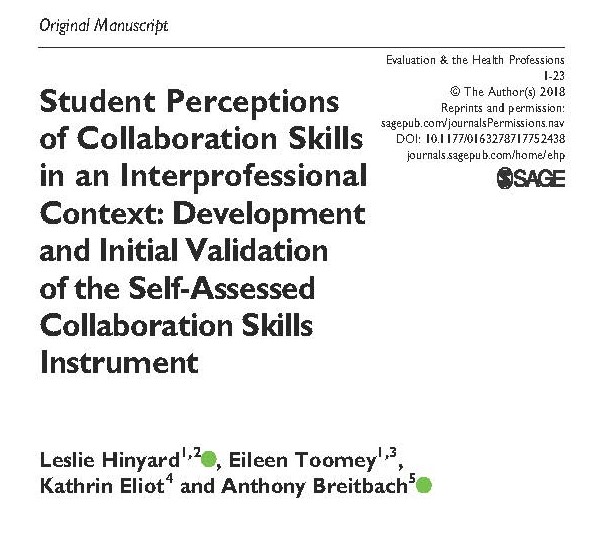
With our colleague Dr. Leslie Hinyard as well as research assistant/statistician Eileen Toomey (a key member of any research project!) we developed and validated the Self-Assessed Collaboration Scale (SACS), that allows students to evaluate their readiness to work in teams.   This brief survey is useful in a variety of team-based contexts including didactic and clinical scenarios.

A paper on this process was published in Evaluation and the Health Professions in January 2018:
http://journals.sagepub.com/doi/full/10.1177/0163278717752438

Using the SACS in IPE 1100

Once the SACS was validated, we used the instrument to see how our students perceived their readiness to work in teams.  We were pleased to see that after a semester in our course, students’ rated themselves as being more prepared for collaboration.   This is good news to know that we are setting our students up for success in future IPE courses – win-win!

These data were presented in Health and Interprofessional Practice in May 2018.
https://commons.pacificu.edu/hip/vol3/iss3/3/

For me, the best parts about embedding scholarship into teaching are:

  • The satisfaction of knowing that what you are doing in your classroom is producing the outcomes you are looking for.  And if it’s not…that you can make changes and re-evaluate.  As educators, we are constantly evolving and the best way to make sure what you are doing is effective is to measure it!
  • Sharing your work with others who are excited about it.  There’s nothing like chatting with colleagues from across the country who are genuinely interested in what you are doing.   The more you talk about your work, the more ideas you get and the next thing you know, another study is born! In fact, we are just getting started on a multi-institution study to look at entry-level learners using the SACS and other validated instruments.  More to come about that project in a future post!


Finally, I would encourage anyone who teaches to think about what they can measure and to get their results out there in the literature.  Even think about writing up your process – others are always looking for “best practices” and ideas for making their teaching more effective.

Good luck and enjoy turning your teaching into research!